Answer(s)
• The Civil War

• The Civil War


War between North and South (1861-1865) over slavery and union.
States where slavery was legal before the Civil War.
States where slavery was prohibited before the Civil War.
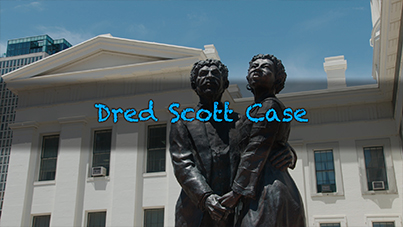
Infamous 1857 ruling denying rights to African Americans.
To formally withdraw from a nation or organization.
DOUGLAS GINSBURG, Federal Judge, U.S. Court of Appeals, D.C. Circuit:
The Civil War was fought between the North and the South – between free states and slave states. Slavery was an issue that had bitterly divided the Founders of the republic. But outlawing slavery likely would have doomed all hope of creating the Constitution – and a single nation.
In the Supreme Court’s infamous Dred Scott decision, Chief Justice Roger Taney asserted slavery was “distinctly and expressly affirmed in the Constitution” – and that the federal government was “pledged to protect it in all future time.” Taney was dead wrong. The Constitution made no such pledge. You won’t even find the words “slave” or “slavery” in the Constitution.
Here’s what you will find: A clause allowing the Congress to end the “importation of such persons,” as of 1808. Thereby effectively ending the slave trade. And the Congress did just that -- effective January 1st 1808.
President Thomas Jefferson hailed the bill – and signed it. If the Constitution had forever protected slavery, as Chief Justice Taney claimed, then President Lincoln could not have issued his Emancipation Proclamation – freeing slaves on Confederate soil. The abolitionist Frederick Douglass -- a former slave himself – noted that the Congress could have outlawed slavery without touching the Constitution.
Instead, the Congress drafted three amendments to abolish slavery and protect the rights of former slaves. Because they’re enshrined in the Constitution, those amendments drove a stake through the heart of the Dred Scott decision.
In short, slavery was not removed from the Constitution -- because it was never there to begin with. The Southern States seceded from the Union to preserve slavery, but the North succeeded in restoring the Union and ending slavery forever.