Answer(s)
• Answer(s)s will vary. [District of Columbia residents should answer that D.C. does not have a governor.]

• Answer(s)s will vary. [District of Columbia residents should answer that D.C. does not have a governor.]


The chief executive of a state government.
A state's fundamental law, similar to the federal Constitution.
A government where power flows from the people through elections.
DOUGLAS GINSBURG, Federal Judge, U.S. Court of Appeals, D.C. Circuit:
If you don’t the name of the governor of your state now, go to the state’s website to look it up – such as Virginia.gov. If you live in the District of Columbia, you have a mayor, instead of a governor.
Some people think the president of the United States has more of an influence in their lives than the governor of their state. That would shock the Framers of the Constitution. The Framers expected the federal government would play a smaller role in our daily lives, because the powers delegated to the federal government mostly concern matters affecting the whole nation.
The Framers left most political power with the states – not with the national government. That way, power resides closer to the people.
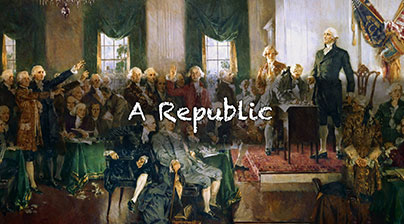
Classroom: “I pledge allegiance …” The Constitution also guarantees each state a republican form of government. Classroom: “and to the republic for which it stands …” Here, republican refers not to the political party but to a republic: a form of government in which power flows from the people. In a republic, we the people elect public servants to serve our interests – not theirs.
Each state has its own constitution to safeguard the rights of its citizens – just as does the United States Constitution.