Answer(s)
• Soviet Union
• USSR
• Russia
• Soviet Union
• USSR
• Russia


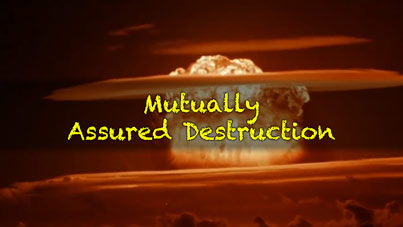
Decades-long rivalry between U.S. and Soviet Union.
Communist superpower that opposed the U.S.
The division between communist and democratic Europe.
American operation to supply West Berlin.
U.S. program to rebuild Europe after WWII.
Military alliance of Western democracies.
DOUGLAS GINSBURG, Federal Judge, U.S. Court of Appeals, D.C. Circuit:
America’s main rival during the Cold War was the USSR: better known as the Soviet Union. The Cold
War was probably the greatest foreign policy battle ever: freedom versus communism – the idea that government should control all aspects of society.
As World War II ended, Soviet armies overran Eastern Europe and, as Winston Churchill put it, an Iron Curtain had descended across the continent. Everyone behind it lived under Soviet tyranny, except West Berlin – protected by the U.S., Britain, and France.
To drive the allies out, Soviet dictator Joseph Stalin blocked all land routes into the city. Led by the United States, the allies responded with the Berlin Airlift – an unprecedented mission to feed and fuel an entire city by air. After 11 months, Stalin gave up and lifted the blockade.
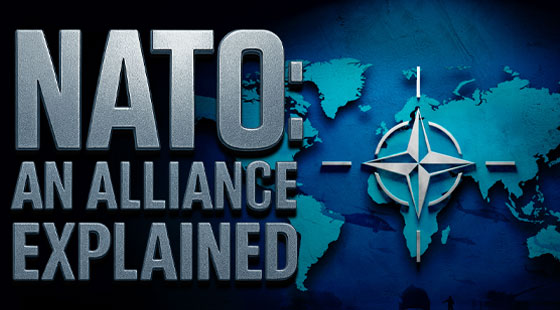
To rebuild a Western Europe ravaged by war, the U.S. launched a mammoth aid project: the Marshall Plan. President Truman also formed the North Atlantic Treaty Organization – NATO: an alliance of Western democracies. And he aided Greece and Turkey to keep communists from seizing power.
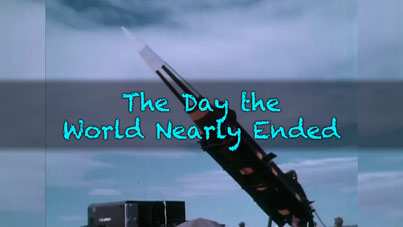
In 1961, the Cold War flared up again in Berlin when communist East Germany built a wall to keep East Berliners from fleeing to the West. In one of the Cold War’s hottest moments, the Soviets placed nuclear missiles in Cuba – in range of Washington, D.C. President Kennedy blockaded Cuba, and the Soviets withdrew their missiles.
So how did the Cold War end? Not with a bang, but a whimper. Exactly how: that’s another question.