Answer(s)
• 1920
• After World War I
• (With the) 19th Amendment

• 1920
• After World War I
• (With the) 19th Amendment


The right to vote.
A person who campaigns for voting rights.
A rule that only landowners could vote.
DOUGLAS GINSBURG, Federal Judge, U.S. Court of Appeals, D.C. Circuit:
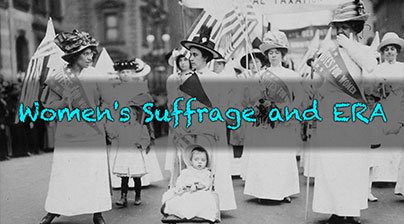
One of the greatest expansions of liberty in America came in 1920 when the Nineteenth Amendment to the Constitution gave women the right to vote. It was a long time coming.
In the young republic, most states limited the vote to people who owned land – mostly White men. Those who paid property taxes, the theory went, were better suited to elect those who would spend the money.
But land was cheap, and most White men could vote. Over the course of the nineteenth century, states dropped the property requirement, thereby expanding suffrage: The right to vote. But not for women, outside a few western states.
The pioneering feminist Elizabeth Cady Stanton wrote, “The power to make laws was the right through which all other rights could be secured.” But some women scoffed at the idea. Even feminist Lucretia Mott dismissed the quest as “ridiculous.”
Then came the Fourteenth Amendment in 1868. It bars the states from denying to any person the privileges of U.S. citizenship. But in the 1875, the Supreme Court ruled that citizenship in itself does not include the right to vote. That right is up to each state. So suffragists launched a campaign to amend the Constitution.
America’s entry into World War I gave suffragists more ammunition. It was hard to argue we were making the world “safe for democracy” while denying women the vote. Passed soon after the war, the Nineteenth Amendment doubled the voting population.
The U.S. is not a democracy and was not meant to be. Actually, it is a republic and always has been. Expanding the vote to include women only strengthened a bedrock principle of America: It’s a republic for all the people.